Ad Hoc Phishing Testing: When One-Off Simulations Help — and When You Need a Real Program
A practical guide to when ad hoc phishing testing helps, where it falls short, and what to look for in a platform.
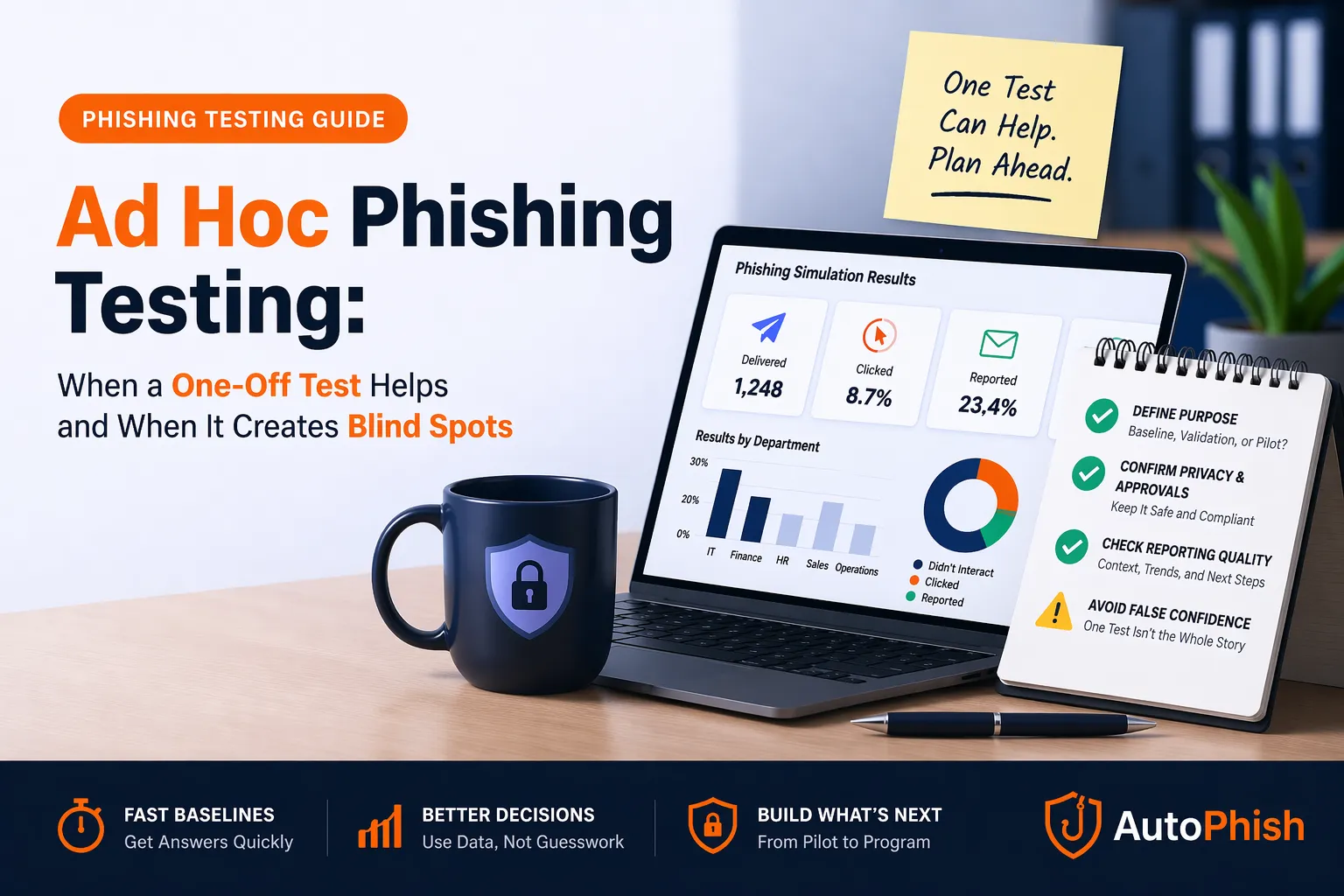
If you are considering ad hoc phishing testing, you are usually trying to answer one practical question:
Do we need a full phishing simulation program yet, or do we just need one well-scoped test right now?
That is a fair question. A one-off campaign can be useful.
But it can also create false confidence, messy reporting, and unnecessary employee friction if you use it as a substitute for a real awareness workflow.
This is the difference security teams should keep in mind:
- Ad hoc phishing testing is useful for a specific decision, validation step, or baseline.
- A phishing simulation program is useful for ongoing behavior change, trend tracking, and governance.
Those are not the same thing.
Safety note: this article is about defensive phishing simulations and awareness measurement. It does not include instructions for real phishing, credential theft, or attack operations.
What ad hoc phishing testing actually means
In practice, ad hoc phishing testing usually means a campaign that is launched for a narrow reason rather than as part of a fixed monthly or quarterly cadence.
Examples include:
- validating whether employees recognize a specific lure pattern
- checking whether a new reporting workflow is being used
- running a baseline before buying a platform
- testing a newly onboarded business unit after a merger or restructuring
- gathering evidence for a specific internal review
That can be perfectly reasonable.
The mistake is assuming that one-off testing gives you the same value as a repeatable awareness program.
It does not.
A single campaign can show you a moment in time. It usually cannot show whether behavior is improving, whether one result was distorted by deliverability, or whether the organization has built stronger reporting habits.
When one-off phishing simulations make sense
1) You need a fast baseline before selecting a platform
Sometimes a security team is early in its phishing-awareness journey and needs a quick read on current risk.
A tightly scoped one-off campaign can help answer questions like:
- Are users reporting suspicious mail at all?
- Which teams need follow-up first?
- Is there obvious confusion around common lure types?
- Does leadership need more evidence before approving a broader rollout?
In that situation, ad hoc phishing testing can be a useful diagnostic tool.
It is especially helpful if you are still comparing operating models, such as the tradeoff between manual campaigns and automation. AutoPhish’s guide to automated phishing testing vs. manual campaigns covers that decision in more detail.
2) You are validating a specific control change
One-off tests can also make sense after a meaningful change, for example:
- a new suspicious-mail reporting button
- updated internal finance approval procedures
- a rewritten employee security policy
- a post-incident remediation cycle
Here, the goal is not “run awareness forever with ad hoc sends.”
The goal is to verify whether a recent change actually improved behavior.
That is a good use case — as long as the campaign has a clearly stated purpose and success criteria.
3) You need a low-drama starting point
Some organizations are not ready for a full recurring program yet.
Maybe legal, HR, compliance, or a works council wants to see how the process will be governed first. Maybe the security team is small. Maybe leadership wants a pilot before committing to a broader program.
In those cases, one carefully designed campaign can be the least disruptive way to start.
The key phrase is carefully designed.
If the first experience feels punitive, confusing, or sloppy, your ad hoc test does not just produce weak data — it can also make a future recurring program harder to launch.
When ad hoc phishing testing becomes a bad habit
1) When every campaign starts from scratch
If every one-off test requires fresh stakeholder debates, manual audience cleanup, manual reporting, and a custom explanation afterwards, the process will not scale.
The security team ends up doing repeated admin work without getting the benefits of a true program:
- trend data
- cleaner governance
- reusable reporting
- predictable employee communications
- easier leadership updates
At that point, “ad hoc” is often just another word for “we have not operationalized this yet.”
2) When the result gets over-interpreted
One campaign can tell you something.
It cannot tell you everything.
For example, a single test might be skewed by:
- messages landing in junk or quarantine
- timing issues during a holiday or busy finance window
- unusual organizational context
- a lure theme that was either too obvious or too niche
This is why reporting quality matters so much. If you want a cleaner evaluation framework, AutoPhish’s article on phishing simulation reporting features is the right checklist.
3) When it is used as a compliance shortcut
A one-off phishing test can support a compliance conversation.
It is not the compliance program.
If you need to show governance, consistency, and evidence over time, one isolated campaign is rarely enough. High-authority guidance like NIST SP 800-53 Rev. 5 treats awareness and training as ongoing control activity, not a one-time stunt.
That matters because many teams accidentally create a brittle story:
- one test was run
- one dashboard screenshot was saved
- nobody can explain what changed afterwards
That is weak evidence.
4) When it undermines employee trust
One-off campaigns can be more politically sensitive than recurring programs because employees have no stable frame for what is happening.
Without clear guardrails, an ad hoc test can feel random or personal.
That is one reason privacy posture matters from day one. If your environment includes strong employee representation or strict internal review, AutoPhish’s guide to privacy-friendly phishing training is worth building into the rollout plan.
What to compare if you may only need occasional testing
If you are buying for ad hoc phishing testing now, but may expand later, do not evaluate platforms like a one-day-only tool.
Evaluate them as a possible path from one-off validation to repeatable program.
1) Setup speed without long-term lock-in
For occasional testing, you do want fast setup.
But “fast setup” should not mean:
- confusing sender setup
- fragile user imports
- manual data cleanup every time
- no reusable approval workflow
A good platform should let you launch a one-off campaign quickly and keep the foundation in place if you decide to run again.
2) Reporting that explains context, not just clicks
For ad hoc phishing testing, reporting needs to answer:
- who was in scope
- what was actually delivered
- what users did
- what follow-up happened
- what caveats affected the result
If the only output is a click chart, you will struggle to use the result with leadership, compliance, or even your own future self.
3) Guardrails that keep the test boring in the best way
Security teams sometimes underestimate how much operational pain comes from “creative” one-off tests.
The better approach is duller and safer:
- clear exclusions for sensitive groups
- non-punitive defaults
- no risky data collection
- defined approval before launch
- immediate training or reporting guidance after the interaction
A good platform should make the safe version of the campaign easier than the reckless version.
4) A clear path from ad hoc to recurring
This is the most important buying question.
Ask vendors:
- Can this one-off campaign become a recurring workflow later?
- Will our reporting stay comparable over time?
- Can we reuse templates, audiences, and approvals?
- Can we shift from named to anonymized reporting if internal expectations change?
- How much extra admin work appears when we move from one campaign to twelve?
If the answer is vague, you may be buying a short-term convenience that becomes a long-term migration project.
A practical decision rule for security teams
If your need sounds like this, ad hoc phishing testing is usually enough for now:
- “We need a baseline.”
- “We need to validate one process change.”
- “We need a pilot before broader rollout.”
- “We need to check one newly added business unit.”
If your need sounds like this, you probably need a real phishing simulation program instead:
- “We need evidence over time.”
- “We want behavior change, not just one campaign result.”
- “We want less manual admin every quarter.”
- “We need predictable reporting for leadership or compliance.”
- “We want awareness to survive staff turnover and busy periods.”
That line matters because the wrong operating model creates waste in both directions:
- a full-blown program may be too much if you only need one decision-supporting test right now
- a one-off tool or process may be too weak if you already know this needs to become an ongoing control
The best ad hoc test is designed like the first step of a program
This is the simplest way to avoid rework.
Even if you are only launching one campaign today, treat it like the beginning of a mature process:
- define the purpose
- define success criteria
- agree on privacy and approval rules
- capture context in the report
- decide what happens next if the result is weak
That way, the campaign is still useful whether you stop after one test or scale into a recurring program.
FAQ
Is ad hoc phishing testing a good replacement for regular awareness training?
Usually no.
It can be useful for a baseline, pilot, or control check, but it rarely delivers the consistency, evidence trail, and behavior-change loop of a recurring phishing simulation program.
What is the biggest risk with one-off phishing simulations?
Overconfidence.
Teams often treat one campaign as a definitive measure, even though the result may be distorted by timing, deliverability, or scenario choice.
Are self-service phishing test platforms a good fit for occasional use?
They can be — if setup, reporting, and guardrails are strong.
The key question is whether the platform can support a one-off campaign without forcing you into messy manual work, and whether it can grow into a recurring workflow later.
Can ad hoc phishing testing help with compliance evidence?
It can contribute evidence, but it should not be presented as a complete compliance answer.
A stronger compliance story usually requires repeatability, approvals, reporting consistency, and documented follow-up over time.
What should we measure in a one-off campaign?
At minimum:
- delivery quality
- report rate
- click or interaction behavior in context
- follow-up actions
- any caveats that make the result less reliable than it looks
Want one-off phishing testing that can grow into a real program?
AutoPhish helps security teams run safe phishing simulations with low admin overhead, privacy-aware reporting, and a clear path from pilot campaigns to repeatable awareness workflows.