ISO 27001 Security Awareness: Where Phishing Simulations Fit Under Annex A 6.3
ISO 27001 does not require a phishing platform, but well-run phishing simulations can make awareness controls more measurable, repeatable, and easier to defend during reviews.
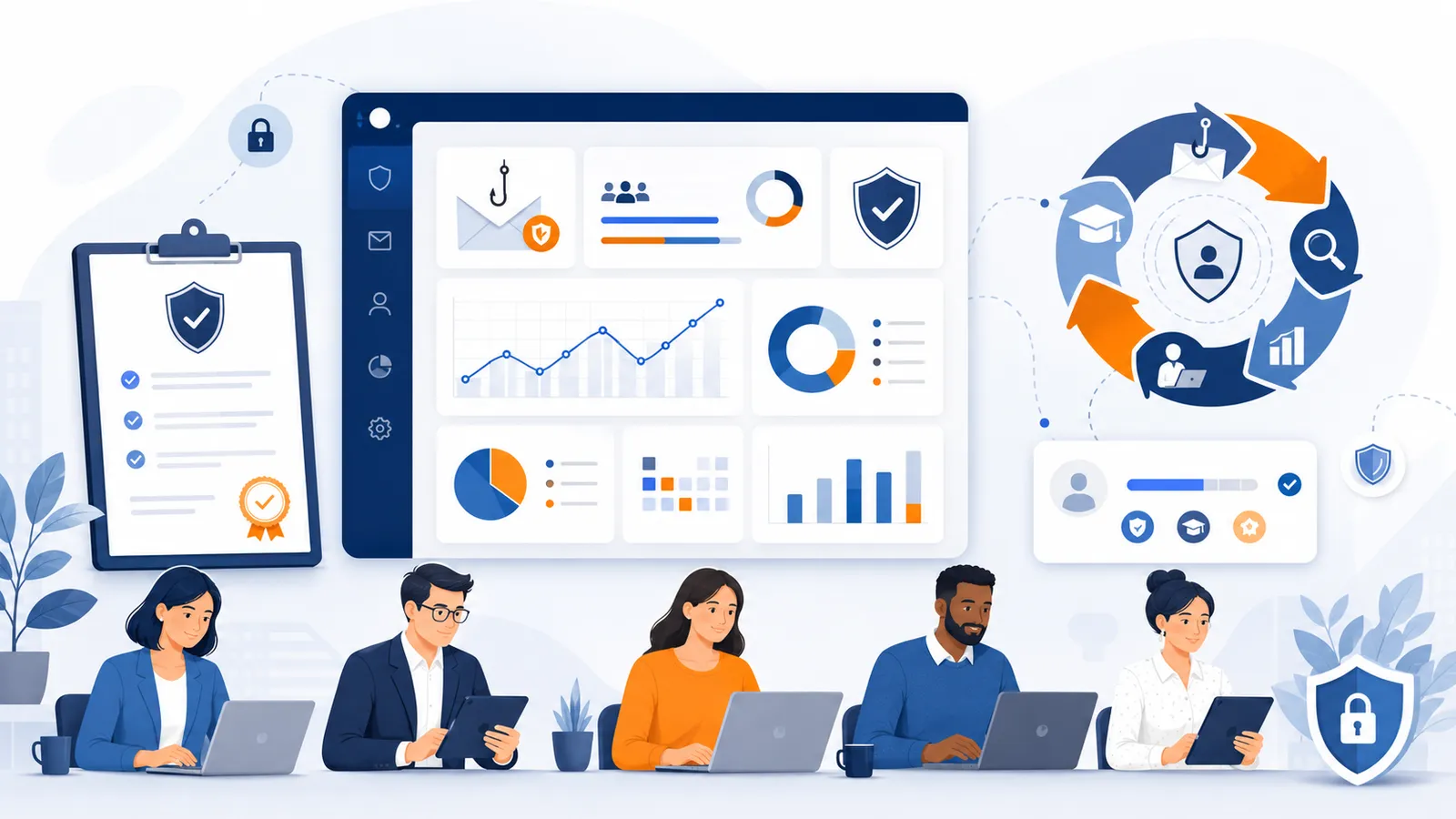
If you are evaluating ISO 27001 phishing simulations, the practical answer is simple: phishing simulations can support Annex A 6.3 awareness objectives, but only when they are run as a documented, repeatable control with clear guardrails, reporting, and follow-up. They do not make an organization “ISO 27001 compliant” by themselves, and any vendor that says otherwise is overselling.
That distinction matters because the query behind this topic usually comes from a real buying or audit question: where do phishing simulations fit inside an ISO 27001-aware security awareness program, and what evidence should we keep?
This guide answers that question for security engineers, IT admins, CISOs, and compliance leads.
Safety note: this article is about defensive phishing simulations and awareness training. It does not include instructions for real phishing, credential theft, payload delivery, or bypassing security controls.
What Annex A 6.3 actually means for phishing simulations
Under ISO/IEC 27001, awareness, education, and training are governance topics, not one-off content exercises.
That matters because many teams still run awareness in one of two weak ways:
- annual training with no measurement beyond attendance
- occasional phishing campaigns with no documented purpose, review path, or follow-up
Neither approach creates strong evidence.
A phishing simulation program becomes useful in an ISO 27001 context when it helps you show that awareness is:
- planned
- recurring
- relevant to job risk
- reviewed over time
- tied to remediation or reinforcement
That is the real value. Not “we sent fake emails,” but “we operate a managed awareness control and can explain how it works.”
Where phishing simulations genuinely help an ISO 27001-aware program
1. They turn awareness into a repeatable control
A repeatable program is easier to defend than ad hoc activity.
Instead of proving that one campaign happened, you can show a structured cycle:
- schedule campaigns on a defined cadence
- scope users or roles intentionally
- capture outcomes consistently
- deliver follow-up coaching or training
- review trends and improve the next cycle
That kind of operating rhythm fits much better with how most teams explain control ownership during internal reviews, customer questionnaires, or certification prep.
2. They give you evidence beyond attendance logs
Awareness evidence gets weak fast when the only artifact is “employees completed training.”
Phishing simulations can add more useful signal, such as:
- campaign history and timing
- coverage by business unit or role
- reporting behavior
- follow-up completion after risky actions
- trend data across multiple cycles
- approvals and admin changes
If you want a concrete benchmark for what good reporting should look like, AutoPhish’s guide to phishing simulation reporting features is a strong starting point.
3. They support role-based awareness instead of generic awareness theater
Not every team faces the same phishing pressure.
Finance, HR, IT admins, executives, procurement, and support teams all see different workflows, lures, and consequences. A stronger ISO 27001-aware program reflects that reality instead of pretending one generic campaign teaches everyone equally well.
That is why role-based design matters:
- scenarios can match real decision context
- coaching can reflect business process risk
- reporting can be reviewed at team level
- awareness becomes easier to explain as a business control
AutoPhish’s article on role-based phishing simulations shows what that maturity looks like in practice.
4. They let you measure remediation, not just failure
Click rate alone is a weak story.
For most security and compliance conversations, the better question is: what happened after the risky action?
A mature platform should help you show things like:
- follow-up training assigned automatically or deliberately
- completion tracked over time
- repeat-risk behavior reduced after coaching
- reporting behavior improving, not just click behavior changing
That moves the conversation away from blame and toward control improvement.
Where phishing simulations do not solve your ISO 27001 problem
This is the part worth stating plainly.
They do not guarantee certification
No phishing platform can make an organization ISO 27001 certified.
Certification depends on the wider management system, risk treatment, governance, evidence, scope, and how controls are actually operated. A phishing simulation product can support one awareness-related part of that picture. It cannot substitute for the rest.
They do not replace technical controls
Awareness supports risk reduction. It does not replace:
- email authentication and filtering
- endpoint and identity controls
- reporting workflows
- incident response
- access reviews
- policy and governance decisions
If your technical foundations are weak, simulations may expose gaps, but they will not fix them by themselves.
They do not justify reckless realism
Some teams overcorrect and assume a “serious” program must feel harsh.
Usually that creates new problems:
- employee trust drops
- reporting quality gets distorted
- HR or works council friction increases
- leadership sees more noise than value
A better approach is safe, explainable, proportionate simulations with clear rules, retention choices, and limited result visibility where appropriate. For EU-heavy environments, AutoPhish’s guide on privacy-friendly phishing training is the right model.
What evidence to keep for ISO 27001 phishing simulations
If you want phishing simulations to support Annex A 6.3 conversations, keep evidence that is plain, consistent, and easy to reproduce.
Program charter
Document:
- the purpose of the phishing simulation program
- who owns it
- who approves campaigns
- what success looks like
- what the program is explicitly not used for
- any excluded themes or sensitive scenario boundaries
Campaign cadence and scope
Keep a record of:
- when campaigns ran
- which groups were included
- which groups were excluded and why
- whether scenarios were general or role-based
- who approved launch
Outcome and follow-up records
Useful evidence usually includes:
- delivery and interaction summaries
- reporting rate or time-to-report trends
- training or coaching assignments
- completion records
- repeated-risk patterns over time
Access, privacy, and retention settings
You should also be able to explain:
- who can see individual-level results
- who only sees aggregate views
- how long data is kept
- whether exports are restricted
- how sensitive cases are handled
Improvement log
After each cycle, capture what changed.
Examples:
- updated reporting instructions
- adjusted role targeting
- refined scenario guardrails
- new coaching content
- changes to admin permissions or review flow
That improvement log is often what turns awareness from “activity” into a defensible control.
What to compare in a phishing simulation platform for ISO 27001-aware teams
If this topic is part of vendor evaluation, ask questions that surface operational maturity rather than demo polish.
1. Can the program run continuously without heavy admin work?
Look for:
- recurring scheduling
- reusable segmentation
- predictable evidence capture
- low-friction imports or syncs
- manageable approvals
If the control only works when one motivated engineer remembers to run it, it is brittle.
2. Can you produce evidence outside the platform UI?
Ask whether the tool supports:
- exportable reports
- trend views across time
- campaign history
- admin or audit logs
- remediation tracking
A beautiful dashboard is less useful than clean, explainable evidence.
3. Are privacy controls strong enough for your environment?
Check for:
- role-based access to results
- aggregate reporting options
- configurable retention
- restricted exports
- clear reviewer boundaries
That is not just a legal concern. It is often what keeps the awareness program trusted enough to survive.
4. Does the platform support role-based and follow-up workflows?
A decent tool should make it practical to tailor awareness by function and show what happened next after a failure or report. Without that, the program often stalls at generic templates and vanity metrics.
5. Can the team explain exactly what the platform does not do?
This is an underrated buying test.
The safer vendor answer is usually something like:
- we support awareness operations
- we help document outcomes and follow-up
- we do not make certification claims for you
That kind of restraint is a good sign.
FAQ
Does ISO 27001 require phishing simulations?
Not specifically. ISO 27001 expects organizations to operate appropriate controls, including awareness-related controls, within a broader management system. Phishing simulations can support that work, but they are one option, not a universal requirement.
Can phishing simulations help with Annex A 6.3?
Yes, when they support awareness, education, reinforcement, and measurable follow-up. They are most useful when documented as a recurring control rather than used as isolated tests.
What is the most useful metric for ISO 27001 phishing simulations?
Usually not click rate alone. Reporting behavior, follow-up completion, repeat-risk reduction, campaign cadence, and reviewable evidence over time tend to be more useful.
Should auditors or managers see every individual failure?
Usually no by default. Controlled access, aggregate reporting, and clearly defined exceptions are often easier to defend than broad visibility into named results.
Can a phishing platform prove ISO 27001 compliance?
No. It can support evidence for awareness activities and remediation workflows, but certification depends on the full management system and how controls are governed across the organization.
The practical takeaway
The best ISO 27001 phishing simulations are not the most dramatic ones. They are the ones your team can run safely, explain clearly, review consistently, and improve over time.
If that is what you need, choose the platform that gives you repeatability, evidence, follow-up, and sane guardrails, not the one making oversized compliance promises.
If you want a low-overhead, privacy-aware way to run phishing simulations and document outcomes cleanly, Sign Up.